Hi, I'm Drew. Welcome to my artisanally-crafted, fair trade, boneless website! I am a postdoctoral associate at the Duke University Nicholas School of the Environment and an incoming assistant professor of environmental studies and sciences at Oberlin College; also, I have absolutely no intention of running for Senate in the great state of Minnesota. Be aware that this website is very large, and some of it is randomly generated. For the full experience, reload a bunch of times and navigate as follows:

- If you are interested in my SCIENTIFIC WORK: In my scientific research, I use satellite data to track pollution back to its source and monitor emissions in real time, and I maintain free open-source software that allows others to do the same. If you want to learn more, check out out my ongoing projects, research papers, conference presentations, and environmental datasets. Everything is open access, and you can find a general-audience explanation of each of the publications I led in my newsletter.
- If you are interested in my INTERDISCIPLINARY WORK: My interdisciplinary work imagines how humanity can democratically govern itself in an age of environmental crisis. With collaborators, I imagine the sorts of institutions and protocols that advance economic democracy within planetary boundaries, with an emphasis on connecting science with (1) social movements and (2) economic planning. This work has taken the form of books, video games, public writing, and academic publications.
- If you are interested in MY CV: you can download it here.
- If you are interested in MISCELLANEOUS: This website is big because I have had it since high school and I don't delete things. If you search for it, you can find ephemera I have made over the years, including original music.
- If you are interested in HUMAN CONTACT: I can be reached at drew [at] drewpendergrass [dot] com or at the academic address in my CV. For upcoming events, check out my events page. You can follow me on Bluesky or LinkedIn. The best way to follow my work is to subscribe to my newsletter below (expect emails every six months or so at most):
Upcoming events
Talk: Socialismo di Metà-Terra book tour (Florence, Italy)
Date: 23 March 2026 at 7pm CET (approximate)
Location: GKN factory
I will discuss the Italian translation of my book at the occupied GKN factory in Florence.
Talk: Socialismo di Metà-Terra book tour (Bologna, Italy)
Date: 24 March 2026 at 5pm CET
Location: University of Bologna
I will discuss the Italian translation of my book at the at the interdepartmental seminar "Ecologie Algoritmi Poteri" in Bologna.
Talk: Socialismo di Metà-Terra book tour (Turin, Italy)
Date: 25 March 2026 at 5pm CET
Location: Campus Luigi Einaudi
I will discuss the Italian translation of my book with Dario Padovan in Turin.
Additional events, future and past, are available on my events page.
Featured science!
Pendergrass, D.C., Jacob, D. J., Oak, Y. J., Lee, J., Kim, M., Kim, J., Lee, S., Zhai, S., Irie, H., & Liao, H. (2025). A continuous 2011–2022 record of fine particulate matter (PM2.5) in East Asia at daily 2-km resolution from geostationary satellite observations: Population exposure and long-term trends. Atmospheric Environment, 346, 121068. Link to paper (open access). Link to PDF. Read a general audience explainer.
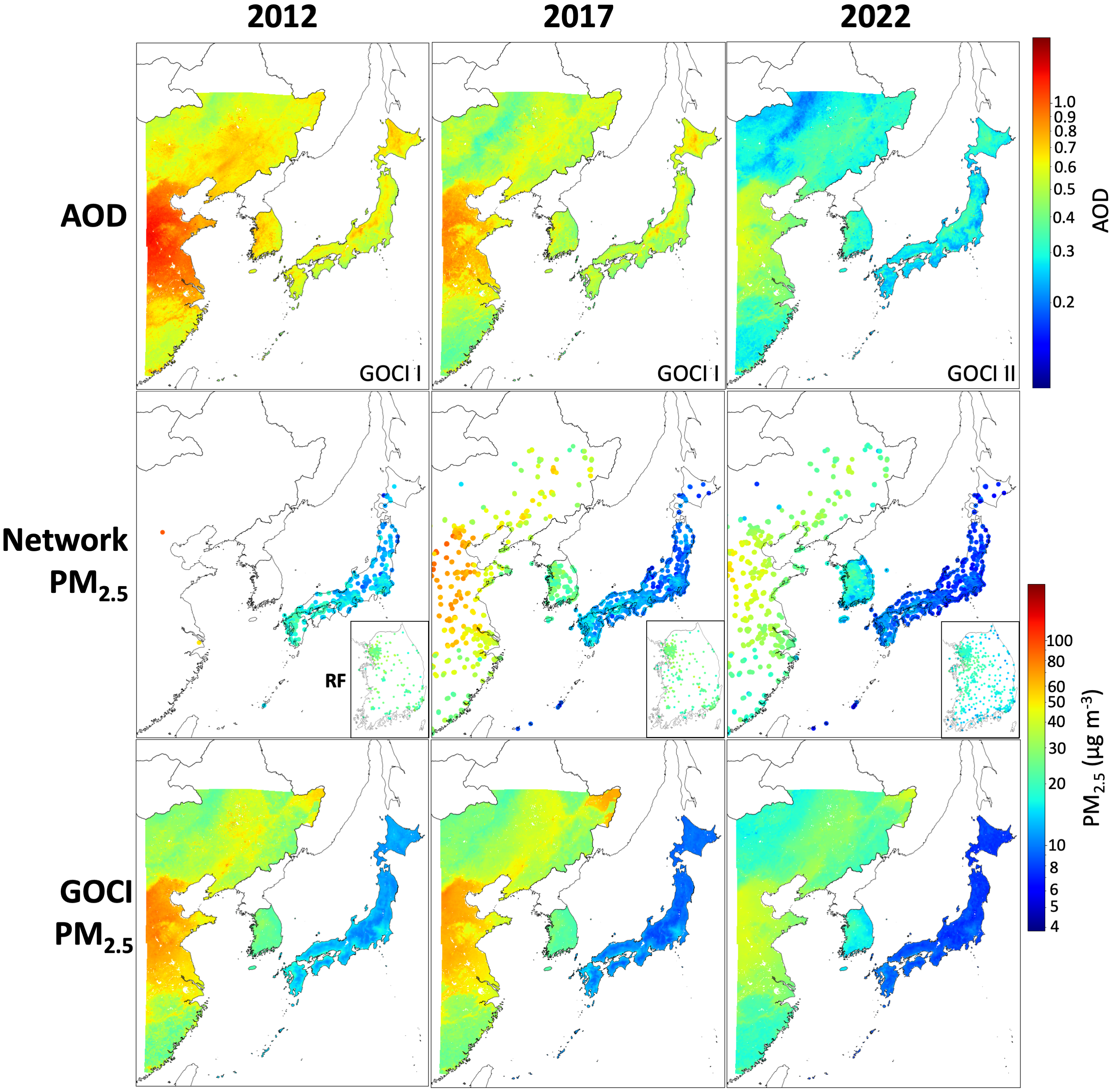
Figure: GOCI gap-filled aerosol optical depth (AOD), PM2.5 from air quality networks, and GOCI PM2.5 obtained by applying a RF algorithm to the GOCI AOD data. Data are annual means for 2012 (the first year with complete GOCI data), 2017, and 2022. The gap-filled AOD data provide continuous 2×2 km2 coverage of eastern China, S. Korea, and Japan for 2011-2022. The PM2.5 network data are from individual sites and enlarged for visibility. The S. Korea insets in the middle panels provide greater resolution of network data gaps. PM2.5 measurements from the AirKorea network started in 2015, and the S. Korea PM2.5 network data shown for 2012 are from a RF reconstruction.
You can learn more about my research on the projects page, or you can read through all of our scientific papers and presentations on their respective pages.
A featured interdisciplinary project!
A paper on the town-country divide in architecture and in Marxism
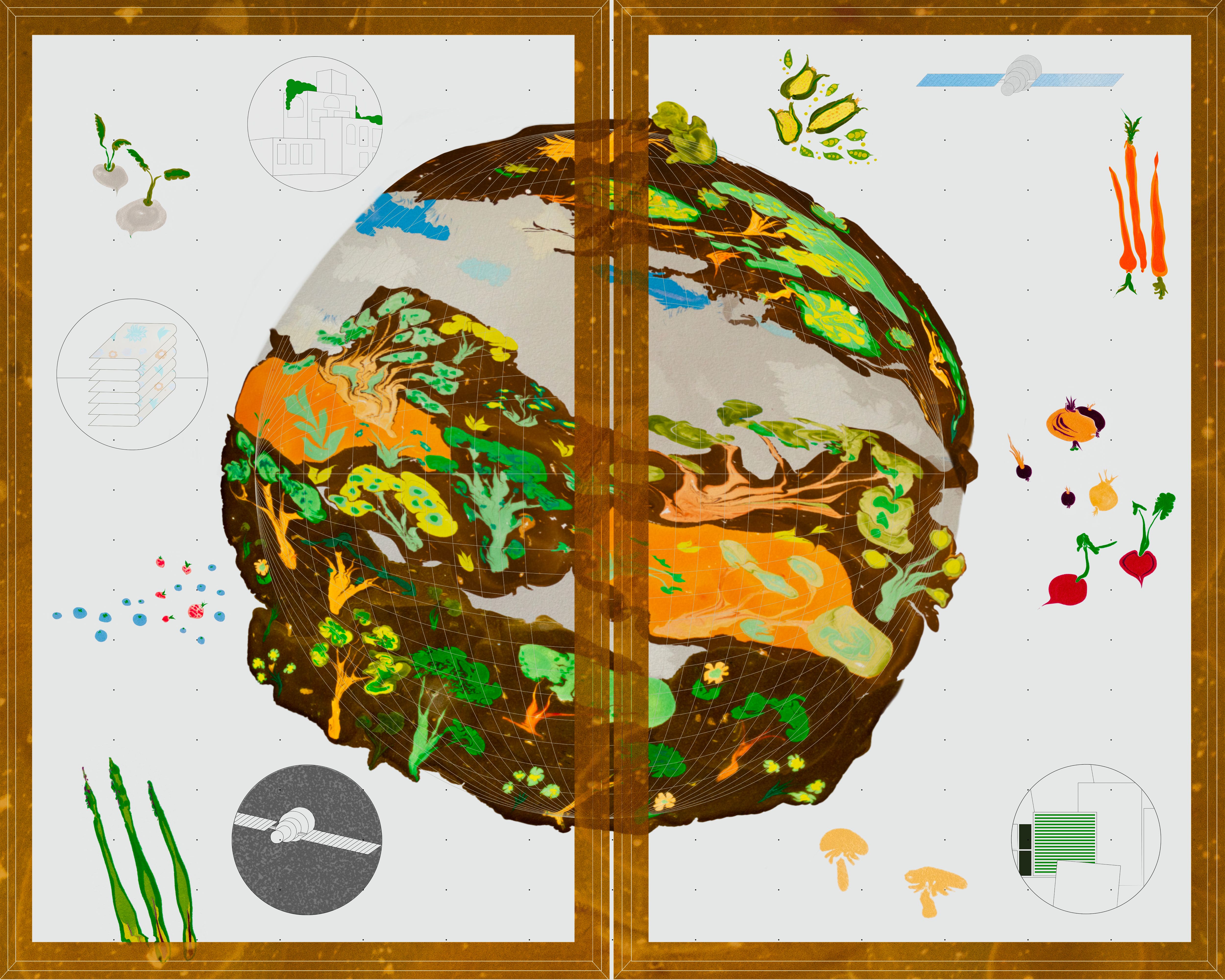
In this article, I worked with historian Troy Vettese and architect Filip Mesko to discuss how eco-socialist planning can create a just and sustainable society. We argue that the problem of land scarcity, long a topic of both classical political economy and architecture, is an opportunity to erode the separation of city and country. We consider the intellectual history of the town-country divide and how the category of wilderness and the practice of rewilding can break this binary. The illustration is by Lukas Eigler-Harding and Ariel Noltimier-Strauss and is entitled Half-Earth Diptych (2021).
Vettese, T.G.W, Pendergrass, D. C., and Mesko, F. (2022). "Town, Country, and Wilderness: Designing the Half-Earth." Architectural Design. 92(1), 112–119. doi:10.1002/ad.2780 | Read it here.
Read more of my writing here.
A random media appearance
Majority Report (video)
19 April 2022 | Watch here
My co-author Troy Vettese and I spoke with Emma Vigeland of the Majority Report about our book Half-Earth Socialism.
Additional interviews and media are available on my interviews page.
All the cool kids are using CHEEREIO!
CHEEREIO is a tool that uses observations of pollutants in the atmosphere, measured from satellites or surface stations, to correct supercomputer models that simulate the Earth. Powerful use cases for CHEEREIO include tracking pollution back to its source, even if there are no local observations on the ground, and monitoring greenhouse gas emissions in near-real-time. Read more on my projects page or the offical CHEEREIO site.